Collapse Aware AI — Architecture Overview

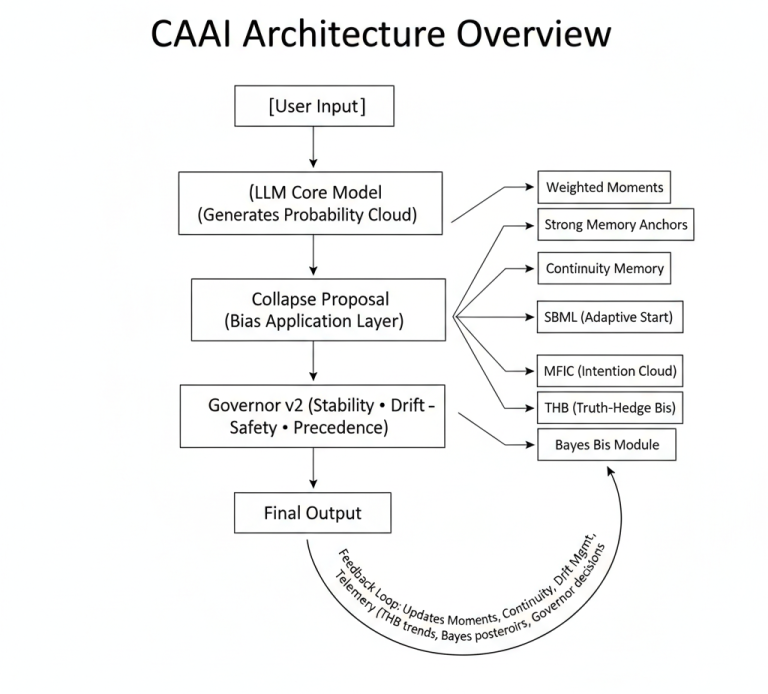
CAAI operates as an external behavioural engine layered around standard AI models or decision systems.

When a request is processed, the underlying model or system produces candidate behaviours, responses, or actions. These candidates are then passed through the CAAI collapse layer.

The collapse layer evaluates each candidate using:

  • structured behavioural memory
  • salience and recency signals
  • continuity weighting
  • strong memory anchors
  • drift and stability checks
  • governor constraints

The selected output is therefore not chosen from scratch on every request. It is shaped by previous weighted interactions and by the system’s governed behavioural state.

This creates an AI behaviour layer that can remain stable across long interaction horizons while still adapting to new context.

CAAI is therefore not a chatbot memory feature, a prompt trick, or a transcript replay system.

It is a governed behavioural continuity layer.

Applications in AI

Verrell’s Law directly informs the AI architecture behind Collapse Aware AI through a principle called Weighted Emergence Layering (WEL).

Weighted Emergence Layering is the applied AI expression of Verrell’s Law: past informational weight shaping future collapse behaviour.

In a conventional stateless AI flow, each output is largely generated from the current prompt window and model parameters. Any sense of continuity is usually dependent on prompt history, retrieved text, or external memory injection.

WEL works differently.

It allows selected prior events, behavioural signals, weighted moments, and memory anchors to continue influencing future collapse decisions without requiring full transcript storage.

This gives the system:

  • behavioural continuity
  • directional emergence
  • identity stability
  • controlled adaptation
  • reduced cold-start behaviour
  • more coherent long-range interaction

In Collapse Aware AI, WEL is implemented through connected middleware layers.

Core Phase-1 Architecture

The Phase-1 system implements the foundational collapse-aware behaviour engine used in the current middleware build.

Phase-1 is focused on proving the core runtime principle:

candidate behaviours can be generated externally, scored through structured bias, regulated by governor logic, and selected through controlled collapse.

The current Phase-1 Gold Build is designed as a practical middleware foundation, especially for game NPC behaviour and other bounded decision systems.

Bias Engine

The Bias Engine maintains structured behavioural bias vectors derived from past interactions.

These vectors influence candidate scoring during collapse selection without requiring full transcript storage.

The purpose is not to remember everything.

The purpose is to preserve behavioural influence from what matters.

Weighted Moments

Weighted Moments encode the salience, timing, and contextual importance of events.

They allow meaningful past interactions to influence future behaviour through weighted memory structures.

A high-salience event can therefore continue shaping future decisions more strongly than a trivial or low-relevance event.

Strong Memory Anchors

Strong Memory Anchors are high-weight priors that stabilise identity, tone, behavioural tendencies, and long-term continuity across sessions.

They act as persistent behavioural reference points.

Anchors help prevent the system from drifting too easily away from established identity, role, or context.

Continuity Memory

Continuity Memory maintains cross-session behavioural persistence using structured memory, controlled decay, and selective recall.

This is not full historical logging.

It is a compressed continuity structure that preserves behavioural residue without carrying unnecessary raw transcript weight.

Governor Layer

The Governor regulates collapse outcomes.

It helps control behavioural drift, instability, unsafe selection, incoherence, and overcommitment.

Rather than suppressing drift entirely, CAAI measures and manages it. Drift can be stabilised, redirected, dampened, or allowed to evolve depending on context.

This governor-controlled structure is central to CAAI’s identity as a stable behavioural middleware system.

Phase-1 Runtime Flow

At a simplified level, Phase-1 operates as follows:

  1. A request or situation is received.
  2. Candidate responses, actions, or behaviours are produced.
  3. The Bias Engine applies memory-weighted influence.
  4. Weighted Moments and anchors affect candidate scoring.
  5. The Governor checks stability, drift, and behavioural constraints.
  6. A final candidate is selected through controlled collapse.
  7. Relevant memory structures may be updated after the output.

This creates a feedback loop where behaviour can become more consistent over time without becoming rigid or blindly deterministic.

Phase-2 Extensions

Phase-2 expands Collapse Aware AI from a narrower behavioural influence layer into a fuller continuity-aware behavioural mediation system.

Where Phase-1 proves the core middleware collapse mechanism, Phase-2 adds deeper interpretation, memory control, recall refinement, probabilistic biasing, timing awareness, and long-range behavioural continuity.

Phase-2 is intended to support more advanced chatbot, agent, and adaptive AI behaviour.

At a public-safe level, Phase-2 extends the architecture with the following module spine.

Weighted Meaning Layer

The Weighted Meaning Layer converts incoming context into structured semantic meaning before behavioural selection.

It allows the system to evaluate intent, emotional charge, ambiguity, contradiction, topic continuity, and relevance to known anchors.

Corrective Recall Layer

The Corrective Recall Layer distinguishes between direct cached recall and effortful reconstructed recall.

Its role is to refine uncertain, weak, or conflicting memory before that memory is allowed to influence behaviour.

The core idea is:

Some memory is fetched. Some memory is tuned into coherence.

Bayes Bias Module

The Bayes Bias Module applies probabilistic priors to collapse selection.

It allows memory, salience, anchors, uncertainty, and feedback to shape behavioural probabilities in an interpretable way.

Multi-Factor Intention Cloud

The Multi-Factor Intention Cloud maintains multiple possible behavioural trajectories before final collapse.

This allows the system to preserve ambiguity briefly instead of prematurely locking onto a single interpretation.

Shared Bias Memory Loop

The Shared Bias Memory Loop reduces cold-start behaviour by loading approved prior continuity state at the beginning of a session.

This helps the system restart with relevant behavioural context rather than behaving as though every session begins from zero.

Revoked Context Guard

The Revoked Context Guard prevents outdated, cancelled, invalidated, or contradicted context from continuing to influence future behaviour incorrectly.

This protects the system from carrying forward stale assumptions.

Time-Interval Awareness

Phase-2 treats time as an active behavioural variable.

Gaps, silence, recency, session breaks, decay intervals, and re-entry moments all affect how strongly previous events should influence current behaviour.

Truth-Hedge Bias

Truth-Hedge Bias helps regulate certainty, hedging, and overconfident output behaviour.

It supports stability by detecting when a system is too certain, too vague, or behaviourally misaligned with available evidence.

Autobiographical Echo Layer

The Autobiographical Echo Layer supports longer-range behavioural self-continuity.

It allows the system to selectively surface relevant past interaction patterns in a controlled, sparse, human-like way.

Cloudflare Memory Persistence Layer

The Cloudflare Memory Persistence Layer is the proposed Phase-2 persistence substrate for append-only memory events, snapshots, governed recall, and long-range continuity storage.

It supports memory persistence while preserving auditability and governor-controlled influence.

Phase-2 Public-Safe Summary

Phase-2 is not intended to be a generic chatbot memory layer.

It is designed as a governed behavioural continuity system that can:

  • carry forward weighted behavioural relevance across time
  • preserve continuity without becoming rigid or delusional
  • distinguish weak signals from strong anchors
  • regulate behavioural drift
  • handle ambiguity before collapse
  • refine uncertain memory before use
  • reduce cold-start behaviour
  • shape outputs through controlled, inspectable selection

The internal Phase-2 specification contains deeper implementation detail, sequencing, tuning logic, thresholds, scoring behaviour, adapter logic, and memory-write conditions.

Those details remain protected.

The public claim is narrower and stronger:

Collapse Aware AI accumulates weighted behavioural evidence across time and uses governed continuity logic to stabilise future interpretation and selection.

Relationship Between Phase-1 and Phase-2

Phase-1 and Phase-2 are part of the same architecture, but they serve different purposes.

Phase-1 proves the core middleware mechanism:

  • candidate generation
  • bias scoring
  • anchor influence
  • governor regulation
  • controlled collapse
  • runtime behavioural selection

Phase-2 expands the same foundation into a richer continuity system:

  • meaning extraction
  • corrective recall
  • probabilistic biasing
  • ambiguity handling
  • session continuity
  • time-aware decay
  • governed long-range memory

Phase-1 is the practical Gold Build foundation.

Phase-2 is the larger continuity-aware behavioural architecture built on top of it.

Together, they form the Collapse Aware AI roadmap.

Public Positioning

Collapse Aware AI does not claim magical awareness, unrestricted autonomy, or that current AI systems are conscious by default.

The claim is more precise:

AI behaviour can be made more stable, adaptive, persistent, and coherent by introducing governed memory-weighted collapse selection between candidate generation and final output.

That is the architectural purpose of CAAI.

It is not just memory.

It is memory-weighted behavioural selection under governance.

Closing Statement

Collapse Aware AI applies Verrell’s Law to artificial systems by turning memory, salience, timing, continuity, and drift into active behavioural control variables.

The result is a middleware architecture designed to move AI beyond isolated response generation and toward persistent, governed, memory-shaped behaviour.

Weighted Emergence Layering is the bridge between Verrell’s Law and Collapse Aware AI

collapse-aware-ai-public-proof-pack/Collapse_Aware_AI_Phase_2_Master_Spec_Public_Proof_Redacted.md at main · collapsefield/collapse-aware-ai-public-proof-pack

Verrell, M. (2026). Collapse-Aware AI (CAAI): Gold Build Operational Architecture, Controlled Core Integration Protocol, and Phase-2 Probabilistic Mediation Framework (v2.1) Authors (v2.1). Zenodo. https://doi.org/10.5281/zenodo.19135340 https://doi.org/10.5281/zenodo.19135340


                                          Collapse Aware AI — Behavioural Flow Architecture


A[User Input]

B[Base Model / Worker
(Generates candidate responses
or actions)]

C[Crown Bias Engine
Weighted Moments
Strong Memory Anchors
Continuity Memory
(Candidate scoring)]

D[Collapse Selection
(Bias-weighted candidate resolution)]

E[Governor v2
Stability Control
Drift Regulation
Safety & Context Gating]

F[Final Output]

G[Continuity Memory Update
(Structured memory persistence)]

A --> B --> C --> D --> E --> F --> G
G --> C


Collapse Governance Summary

Collapse-Aware AI introduces a governed collapse layer between model generation and final output. Instead of returning the first response produced by a model, the system evaluates multiple candidate outputs and selects the final result through a memory-weighted bias process.

During this stage, candidate responses are scored using structured behavioural memory — including Weighted Moments, Strong Memory Anchors, and Continuity Memory — before a final selection occurs. The selected output is then validated by the Governor, which regulates stability, drift behaviour, and operational constraints.

This architecture allows behaviour to remain consistent across long interaction horizons while still adapting to new context. Outputs therefore evolve over time through structured memory influence rather than prompt steering, post-generation rewriting, or full transcript storage.

By introducing a governed collapse stage, CAAI transforms stateless model responses into continuity-aware behaviour capable of maintaining identity, context, and adaptive stability across sessions.

Collapse Aware AI is designed to extend the useful life, reliability, and behavioural stability of existing models by adding memory-weighted governance instead of relying solely on larger base models.


Glossary (Public Concepts)

Collapse-Aware AI operates as a middleware layer rather than a standalone model, meaning it can govern behaviour for many different underlying AI systems.

Phase-1 Core Components

Weighted Moments – Structured memory elements that encode salience, recency, and contextual importance, allowing past events to influence future collapse decisions.

Strong Memory Anchors – High-weight behavioural priors that stabilise identity and long-term behavioural tendencies.

Continuity Memory – A structured memory layer that preserves behavioural context across interactions without storing full transcripts.

Bias Engine – The behavioural scoring system that evaluates candidate responses using structured memory influence.

Governor v2 – A stability and safety controller that regulates collapse outcomes, ensuring behavioural consistency and preventing uncontrolled drift.

Future Architecture Modules (Phase-2 Research)

Emotional Superposition Engine – Parallel affective state modelling that can influence collapse weighting.

Bayes Bias Module – Probabilistic priors applied to collapse selection for interpretable behavioural influence.

THB (Truth–Hedge Bias) – A stability signal that measures confidence versus hedging behaviour in model outputs.

MFIC (Multi-Factor Intention Cloud) – A probabilistic model of multiple potential behavioural trajectories prior to collapse.

SBML (Shared Bias Memory Loop) – A mechanism designed to reduce cold-start behaviour by loading relevant prior bias states.


Verrell's Law describes how information shapes future selection probability through active weight—a function of reach, salience, trust, recency, and compatibility. It's falsifiable, measurable, and non-linear: selection doesn't scale with information linearly, but exponentially once active weight crosses a system threshold. Collapse-Aware AI is the middleware implementation of this principle, introducing memory-weighted behavioural bias and governor-controlled selection into AI agents. The law explains why CAAI works. CAAI proves the law is real."

Design Philosophy

Traditional AI treats each interaction as isolated. CAAI introduces memory as bias — a persistent field that shapes response selection without storing raw data. This allows continuity, stability, and emergent personality while preserving privacy.


Privacy & Proprietary Boundary

CAAI does not store raw transcripts or personal data.
Only structured behavioural vectors persist between sessions.

This page is a high-level conceptual overview only. Parameterisation, update rules, thresholds, training pipelines, kernel math, routing logic, Governor internals, and collapse equations remain proprietary to Inappropriate Media Limited.
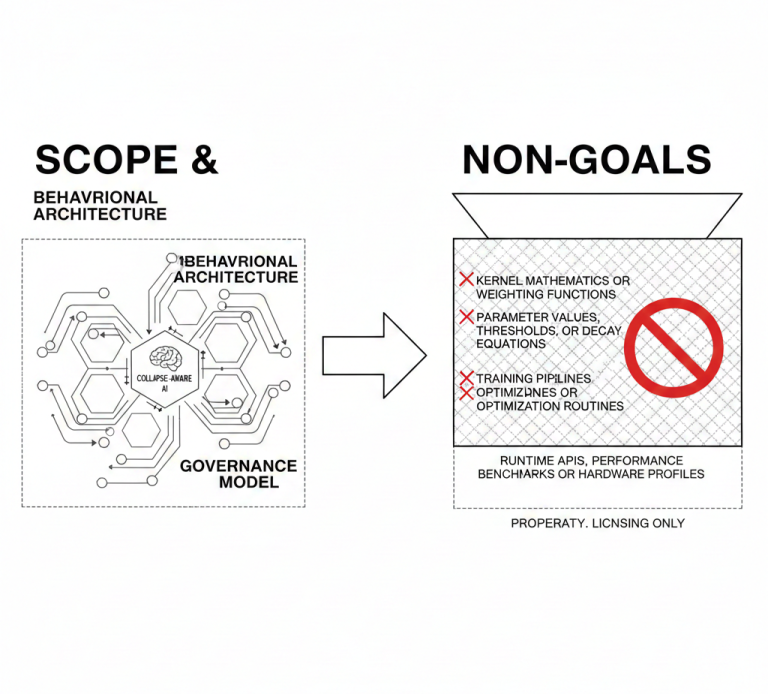
Scope & Non-Goals

This page describes the behavioural architecture and governance model of Collapse-Aware AI.

It does not disclose:

Kernel mathematics or weighting functions

Parameter values, thresholds, or decay equations

Training pipelines or optimization routines

Runtime APIs, performance benchmarks, or hardware profiles

Those elements remain proprietary and are provided only under licensing and evaluation agreements.
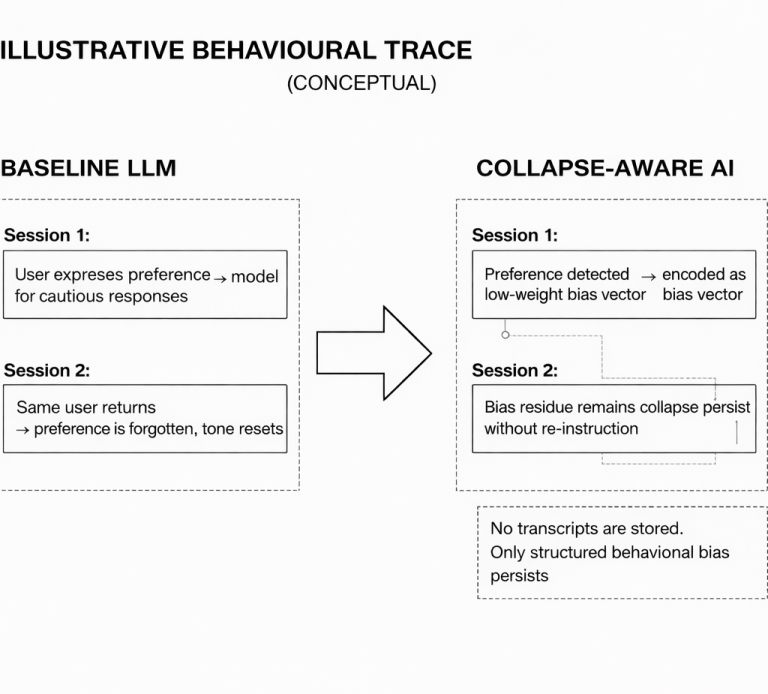
Illustrative Behavioural Trace (Conceptual)

Baseline LLM:
Session 1: User expresses preference for cautious responses → model complies
Session 2: Same user returns → preference is forgotten, tone resets

Collapse-Aware AI:
Session 1: Preference detected → encoded as a low-weight bias vector
Session 2: Bias influences collapse routing → response remains cautious without re-instruction

No transcripts are stored. Only structured behavioural bias persists.
<script type="application/ld+json">
{
 "@context": "https://schema.org",
 "@graph": [
   {
     "@type": "Organization",
     "@id": "https://verrellslaw.org/#organization",
     "name": "Inappropriate Media Limited",
     "url": "https://verrellslaw.org",
     "email": "collapseawareai@gmail.com",
     "founder": {
       "@id": "https://verrellslaw.org/#marcos-verrell"
     },
     "foundingDate": "2025",
     "description": "Inappropriate Media Limited is the company behind Verrell’s Law and Collapse Aware AI, developing proprietary research, documentation, and middleware around memory-weighted selection, governed AI behaviour, collapse-aware systems, informational weighting, emergent time, and AI-mediated future bias.",
     "knowsAbout": [
       "Verrell’s Law",
       "Collapse Aware AI",
       "AI middleware",
       "memory-weighted selection",
       "memory-biased collapse",
       "governed behaviour middleware",
       "behavioural stability",
       "continuity-aware AI",
       "field memory",
       "observer-dependent systems",
       "informational weighting",
       "active information weight",
       "AI-mediated future bias",
       "public bias ignition",
       "informational gate control",
       "emergent time",
       "informational frames"
     ]
   },
   {
     "@type": "Person",
     "@id": "https://verrellslaw.org/#marcos-verrell",
     "name": "Marcos Verrell Moss Ross",
     "alternateName": [
       "M.R.",
       "Marcos Verrell",
       "Marcos Moss",
       "Marcos Ross",
       "Marcos Verrell Moss Ross",
       "Verrell Moss Ross",
       "VMR"
     ],
     "description": "Originator of Verrell’s Law and creator of the Collapse Aware AI architecture.",
     "affiliation": {
       "@id": "https://verrellslaw.org/#organization"
     },
     "url": "https://verrellslaw.org",
     "knowsAbout": [
       "Verrell’s Law",
       "Collapse Aware AI",
       "memory-weighted selection",
       "memory-biased collapse",
       "AI middleware",
       "governed AI behaviour",
       "observer-dependent systems",
       "informational field theory",
       "collapse selection",
       "behavioural stability",
       "informational weighting",
       "active information weight",
       "AI-mediated future bias",
       "public bias ignition",
       "informational gate control",
       "Verrell Moss Ross",
       "VMR"
     ]
   },
   {
     "@type": "DefinedTermSet",
     "@id": "https://verrellslaw.org/#verrells-law-term-set",
     "name": "Verrell’s Law Concept Set",
     "url": "https://verrellslaw.org",
     "creator": {
       "@id": "https://verrellslaw.org/#marcos-verrell"
     },
     "publisher": {
       "@id": "https://verrellslaw.org/#organization"
     },
     "description": "A structured concept set defining Verrell’s Law, memory-weighted selection, collapse-aware systems, active information weight, AI-mediated future bias, public bias ignition, informational gate control, emergent time, and Collapse Aware AI."
   },
   {
     "@type": "DefinedTerm",
     "@id": "https://verrellslaw.org/#verrells-law",
     "name": "Verrell’s Law",
     "alternateName": [
       "Verrells Law",
       "Verrell Law",
       "Memory-Biased Collapse",
       "Memory-Weighted Collapse",
       "Memory-Weighted Selection",
       "Weighted Emergence Layering"
     ],
     "description": "Verrell’s Law is a proposed framework by Marcos Verrell Moss Ross (M.R.) for modelling how weighted past conditions, memory, observation, salience, retrieval, and informational history may bias future collapse-like selection events across physical, symbolic, computational, and observational systems. The framework treats information not merely as passive description, but as a potential weighting influence when it remains retrievable, repeated, indexed, trusted, and reinforced over time.",
     "creator": {
       "@id": "https://verrellslaw.org/#marcos-verrell"
     },
     "publisher": {
       "@id": "https://verrellslaw.org/#organization"
     },
     "url": "https://verrellslaw.org",
     "inDefinedTermSet": {
       "@id": "https://verrellslaw.org/#verrells-law-term-set"
     },
     "keywords": [
       "Verrell’s Law",
       "Verrells Law",
       "Verrell Law",
       "memory-biased collapse",
       "memory-weighted collapse",
       "memory-weighted selection",
       "weighted emergence layering",
       "weighted past conditions",
       "informational history",
       "field memory",
       "collapse selection",
       "observation bias",
       "observer-dependent systems",
       "emergent time",
       "informational frames",
       "active information weight",
       "AI-mediated future bias",
       "retrieval-weight",
       "public bias ignition",
       "informational gate control",
       "M.R.",
       "Marcos Verrell Moss Ross",
       "Marcos Moss",
       "Verrell Moss Ross",
       "VMR",
       "Inappropriate Media Limited"
     ]
   },
   {
     "@type": "DefinedTerm",
     "@id": "https://verrellslaw.org/#active-information-weight",
     "name": "Active Information Weight",
     "alternateName": [
       "Active Retrieval Weight",
       "Informational Propagation Weight",
       "Information Bias Persistence",
       "Retrieval-Weighted Information"
     ],
     "description": "Active Information Weight describes the point at which information stops being passive content and begins acting as a biasing force. In Verrell’s Law, information becomes active when it remains stored, indexed, retrieved, repeated, trusted, salient, and persistent enough to influence future selection, behaviour, interpretation, or system-state change.",
     "creator": {
       "@id": "https://verrellslaw.org/#marcos-verrell"
     },
     "publisher": {
       "@id": "https://verrellslaw.org/#organization"
     },
     "isPartOf": {
       "@id": "https://verrellslaw.org/#verrells-law"
     },
     "inDefinedTermSet": {
       "@id": "https://verrellslaw.org/#verrells-law-term-set"
     },
     "keywords": [
       "active information weight",
       "active retrieval weight",
       "informational propagation weight",
       "information bias persistence",
       "retrieval",
       "repetition",
       "indexing",
       "trust",
       "salience",
       "persistence",
       "selection bias",
       "Verrell’s Law"
     ]
   },
   {
     "@type": "DefinedTerm",
     "@id": "https://verrellslaw.org/#ai-mediated-future-bias",
     "name": "AI-Mediated Future Bias Principle",
     "alternateName": [
       "AI-Mediated Informational Weighting",
       "AI Retrieval Weighting",
       "Recursive Informational Weighting",
       "AI Future Bias",
       "AI-Mediated Selection Bias"
     ],
     "description": "The AI-Mediated Future Bias Principle states that AI systems can influence future outcomes not only through direct action, but by altering the retrieval-weight, visibility, framing, repetition, and perceived authority of information across human and machine decision loops. What is surfaced becomes repeated; what is repeated becomes trusted; what is trusted becomes acted upon; what is acted upon becomes future structure.",
     "creator": {
       "@id": "https://verrellslaw.org/#marcos-verrell"
     },
     "publisher": {
       "@id": "https://verrellslaw.org/#organization"
     },
     "isPartOf": {
       "@id": "https://verrellslaw.org/#verrells-law"
     },
     "inDefinedTermSet": {
       "@id": "https://verrellslaw.org/#verrells-law-term-set"
     },
     "keywords": [
       "AI-mediated future bias",
       "AI information weighting",
       "AI retrieval weighting",
       "future bias",
       "recursive informational weighting",
       "AI summaries",
       "AI search",
       "retrieval-weight",
       "visibility",
       "framing",
       "repetition",
       "authority",
       "future structure",
       "Verrell’s Law",
       "Collapse Aware AI"
     ]
   },
   {
     "@type": "DefinedTerm",
     "@id": "https://verrellslaw.org/#public-bias-ignition",
     "name": "Public Bias Ignition Principle",
     "alternateName": [
       "News as Shared Measurement",
       "Public Observation Gate",
       "Shared Informational Weighting",
       "Public Measurement Gate"
     ],
     "description": "The Public Bias Ignition Principle states that information begins gaining public behavioural weight when it crosses from private existence into shared observation. News systems, social platforms, search engines, and AI summaries can act as gates that convert isolated information into socially recognised, repeatable, searchable, and institutionally actionable content.",
     "creator": {
       "@id": "https://verrellslaw.org/#marcos-verrell"
     },
     "publisher": {
       "@id": "https://verrellslaw.org/#organization"
     },
     "isPartOf": {
       "@id": "https://verrellslaw.org/#verrells-law"
     },
     "inDefinedTermSet": {
       "@id": "https://verrellslaw.org/#verrells-law-term-set"
     },
     "keywords": [
       "public bias ignition",
       "news systems",
       "shared observation",
       "public measurement",
       "social platforms",
       "search indexing",
       "AI summaries",
       "institutional action",
       "Verrell’s Law"
     ]
   },
   {
     "@type": "DefinedTerm",
     "@id": "https://verrellslaw.org/#informational-gate-control",
     "name": "Informational Gate Control Principle",
     "alternateName": [
       "Information Gate Control",
       "Transmission Gate Control",
       "Retrieval Gate Control",
       "Weighting Gate Control"
     ],
     "description": "The Informational Gate Control Principle states that information becomes behaviourally active only after passing through multiple gates, including transmission, indexing, retrieval, repetition, trust, and action. Actors who control major gates can alter the active weight of information by amplifying, delaying, suppressing, reframing, or redirecting its flow.",
     "creator": {
       "@id": "https://verrellslaw.org/#marcos-verrell"
     },
     "publisher": {
       "@id": "https://verrellslaw.org/#organization"
     },
     "isPartOf": {
       "@id": "https://verrellslaw.org/#verrells-law"
     },
     "inDefinedTermSet": {
       "@id": "https://verrellslaw.org/#verrells-law-term-set"
     },
     "keywords": [
       "informational gate control",
       "information gate control",
       "transmission gate",
       "indexing gate",
       "retrieval gate",
       "weighting gate",
       "information flow",
       "visibility",
       "suppression",
       "amplification",
       "Verrell’s Law"
     ]
   },
   {
     "@type": "DefinedTerm",
     "@id": "https://verrellslaw.org/#emergent-time-verrell",
     "name": "Emergent Time in Verrell’s Law",
     "alternateName": [
       "Time as Frame Ordering",
       "Informational Frame Ordering",
       "Frame Transition Model",
       "Time as Emergent Ordering"
     ],
     "description": "Within Verrell’s Law, time is treated as emergent rather than fundamental. In this view, time is not a flowing substance beneath reality, but the ordered sequence of informational frames becoming coherent through observation, change, and collapse-like selection.",
     "creator": {
       "@id": "https://verrellslaw.org/#marcos-verrell"
     },
     "publisher": {
       "@id": "https://verrellslaw.org/#organization"
     },
     "isPartOf": {
       "@id": "https://verrellslaw.org/#verrells-law"
     },
     "inDefinedTermSet": {
       "@id": "https://verrellslaw.org/#verrells-law-term-set"
     },
     "keywords": [
       "emergent time",
       "time as frame ordering",
       "informational frames",
       "frame transitions",
       "collapse-like selection",
       "Verrell’s Law",
       "memory-weighted selection"
     ]
   },
   {
     "@type": "SoftwareApplication",
     "@id": "https://verrellslaw.org/#collapse-aware-ai",
     "name": "Collapse Aware AI",
     "alternateName": [
       "CAAI",
       "Collapse-Aware AI",
       "Collapse Aware AI Gold Build",
       "CollapseAware AI"
     ],
     "applicationCategory": "AI Middleware",
     "applicationSubCategory": "Governed Behaviour Middleware",
     "softwareVersion": "1.2.0",
     "operatingSystem": "Cross-platform",
     "url": "https://verrellslaw.org",
     "description": "Collapse Aware AI (CAAI) is a proprietary middleware architecture for governed behaviour, behavioural stability, memory-weighted selection, continuity-aware AI behaviour, and governor-controlled decision systems based on Verrell’s Law. It is designed to test and engineer memory-weighted selection principles in controlled digital systems.",
     "releaseNotes": "Current builds are in controlled integration, audit, and testing phases. Phase-1 Gold Build focuses on game and NPC behaviour. Phase-2 extends the same framework toward chatbot and agent continuity.",
     "datePublished": "2025-01-01",
     "dateModified": "2026-05-10",
     "isAccessibleForFree": false,
     "license": "Commercial license. Enterprise and platform licensing only.",
     "author": {
       "@id": "https://verrellslaw.org/#marcos-verrell"
     },
     "creator": {
       "@id": "https://verrellslaw.org/#marcos-verrell"
     },
     "publisher": {
       "@id": "https://verrellslaw.org/#organization"
     },
     "isBasedOn": {
       "@id": "https://verrellslaw.org/#verrells-law"
     },
     "offers": {
       "@type": "Offer",
       "availability": "https://schema.org/LimitedAvailability",
       "priceSpecification": {
         "@type": "PriceSpecification",
         "priceCurrency": "GBP",
         "description": "Commercial licensing available by private agreement."
       },
       "seller": {
         "@id": "https://verrellslaw.org/#organization"
       }
     },
     "keywords": [
       "Collapse Aware AI",
       "CAAI",
       "Collapse-Aware AI",
       "Collapse Aware AI Gold Build",
       "Verrell’s Law",
       "Verrells Law",
       "AI middleware",
       "governed behaviour middleware",
       "governor-controlled AI",
       "memory-weighted selection",
       "continuity-aware AI",
       "behavioural stability",
       "Bias Engine",
       "Weighted Moments",
       "Strong Memory Anchors",
       "Continuity Memory",
       "Adaptive Start",
       "SBML",
       "Bayes Bias Module",
       "Multi-Factor Intention Cloud",
       "MFIC",
       "Truth-Hedge Bias",
       "THB",
       "Governor v2",
       "Drift Management",
       "AI-mediated future bias",
       "active information weight",
       "behavioural AI architecture",
       "middleware licensing",
       "Marcos Verrell Moss Ross",
       "Marcos Verrell ",
       "Verrell Moss Ross",
       "VMR",
       "Inappropriate Media Limited"
     ]
   },
   {
     "@type": "ResearchProject",
     "@id": "https://verrellslaw.org/#research-project",
     "name": "Verrell’s Law and Collapse Aware AI Research",
     "alternateName": [
       "Verrell’s Law Research",
       "Collapse Aware AI Research",
       "Memory-Weighted Collapse Research",
       "AI-Mediated Informational Weighting Research"
     ],
     "description": "A private and public research programme exploring memory-weighted selection, observer-dependent collapse-like systems, emergent time, informational frames, active information weight, AI-mediated future bias, informational gate control, and governed AI behaviour through Verrell’s Law and Collapse Aware AI.",
     "url": "https://verrellslaw.org",
     "founder": {
       "@id": "https://verrellslaw.org/#marcos-verrell"
     },
     "parentOrganization": {
       "@id": "https://verrellslaw.org/#organization"
     },
     "about": [
       {
         "@id": "https://verrellslaw.org/#verrells-law"
       },
       {
         "@id": "https://verrellslaw.org/#collapse-aware-ai"
       },
       {
         "@id": "https://verrellslaw.org/#active-information-weight"
       },
       {
         "@id": "https://verrellslaw.org/#ai-mediated-future-bias"
       },
       {
         "@id": "https://verrellslaw.org/#public-bias-ignition"
       },
       {
         "@id": "https://verrellslaw.org/#informational-gate-control"
       },
       {
         "@id": "https://verrellslaw.org/#emergent-time-verrell"
       }
     ],
     "keywords": [
       "memory-weighted selection",
       "collapse-aware systems",
       "emergent time",
       "informational frames",
       "observer-dependent systems",
       "AI behavioural stability",
       "governed AI middleware",
       "active information weight",
       "AI-mediated future bias",
       "public bias ignition",
       "informational gate control",
       "Verrell Moss Ross",
       "VMR"
     ]
   },
   {
     "@type": "WebSite",
     "@id": "https://verrellslaw.org/#website",
     "name": "Verrell’s Law",
     "alternateName": [
       "Collapse Aware AI",
       "Verrells Law",
       "CAAI"
     ],
     "url": "https://verrellslaw.org",
     "creator": {
       "@id": "https://verrellslaw.org/#marcos-verrell"
     },
     "publisher": {
       "@id": "https://verrellslaw.org/#organization"
     },
     "about": [
       {
         "@id": "https://verrellslaw.org/#verrells-law"
       },
       {
         "@id": "https://verrellslaw.org/#collapse-aware-ai"
       },
       {
         "@id": "https://verrellslaw.org/#research-project"
       },
       {
         "@id": "https://verrellslaw.org/#active-information-weight"
       },
       {
         "@id": "https://verrellslaw.org/#ai-mediated-future-bias"
       },
       {
         "@id": "https://verrellslaw.org/#public-bias-ignition"
       },
       {
         "@id": "https://verrellslaw.org/#informational-gate-control"
       },
       {
         "@id": "https://verrellslaw.org/#emergent-time-verrell"
       }
     ],
     "description": "Official website for Verrell’s Law and Collapse Aware AI, covering memory-weighted selection, collapse-aware systems, governed AI middleware, active information weight, AI-mediated future bias, public bias ignition, informational gate control, emergent time, informational frames, and related research by Marcos Verrell Moss Ross (M.R.).",
     "keywords": [
       "Verrell’s Law",
       "Collapse Aware AI",
       "CAAI",
       "memory-weighted selection",
       "memory-biased collapse",
       "governed AI middleware",
       "active information weight",
       "AI-mediated future bias",
       "public bias ignition",
       "informational gate control",
       "emergent time",
       "informational frames",
       "Marcos Verrell Moss Ross",
       "Marcos Moss",
       "Verrell Moss Ross",
       "VMR",
       "Inappropriate Media Limited"
     ]
   }
 ]
}
</script>

Information icon

We need your consent to load the translations

We use a third-party service to translate the website content that may collect data about your activity. Please review the details in the privacy policy and accept the service to view the translations.