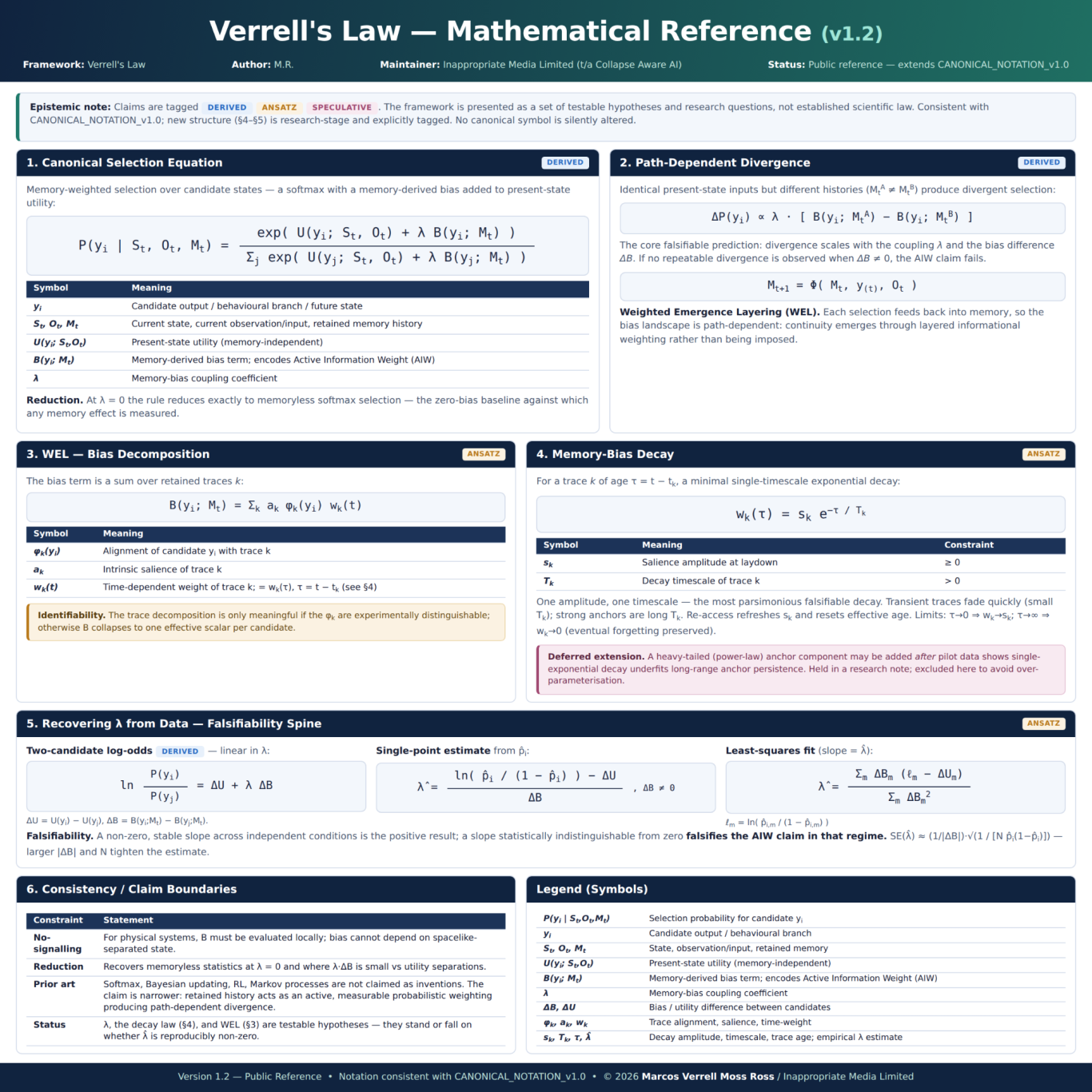
Verrell’s Law is a retained-state selection framework for complex systems.
It proposes that prior interactions can leave persistent state changes, and that those retained changes can bias the probability landscape of future outcomes, even when present inputs appear similar or unchanged.
The result is path-dependent divergence: systems with different retained histories may not evolve toward the same future state.
The framework explores this principle across computational, biological, cognitive, symbolic, observational, social, and other complex systems.
A central research direction is whether retained state, memory, observation, measurement, and information-retention processes can act as measurable bias terms in selection dynamics. The precise mechanisms responsible for such effects may differ between domains and remain an active area of investigation.
Verrell’s Law treats retained information as a potential source of directional weighting that can influence future state selection.
Its claims are presented as testable hypotheses and research questions rather than established scientific law.
The central question is whether retained history can be defined, measured, and tested as a contributor to selection bias across different classes of systems.
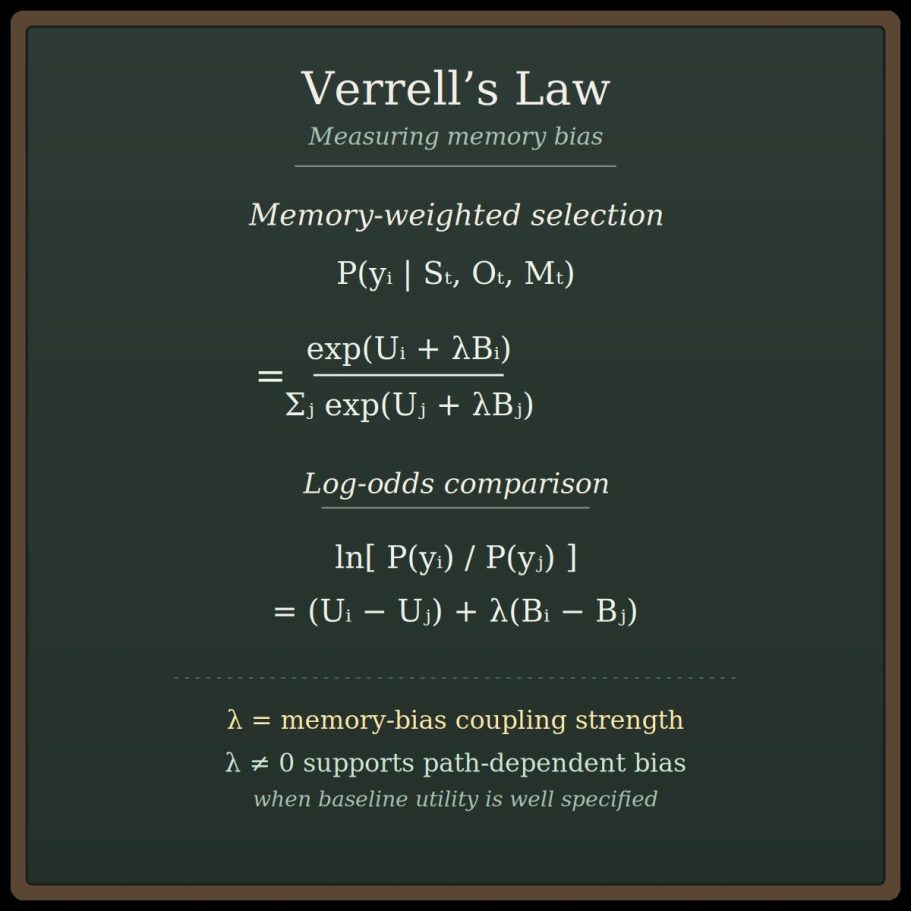
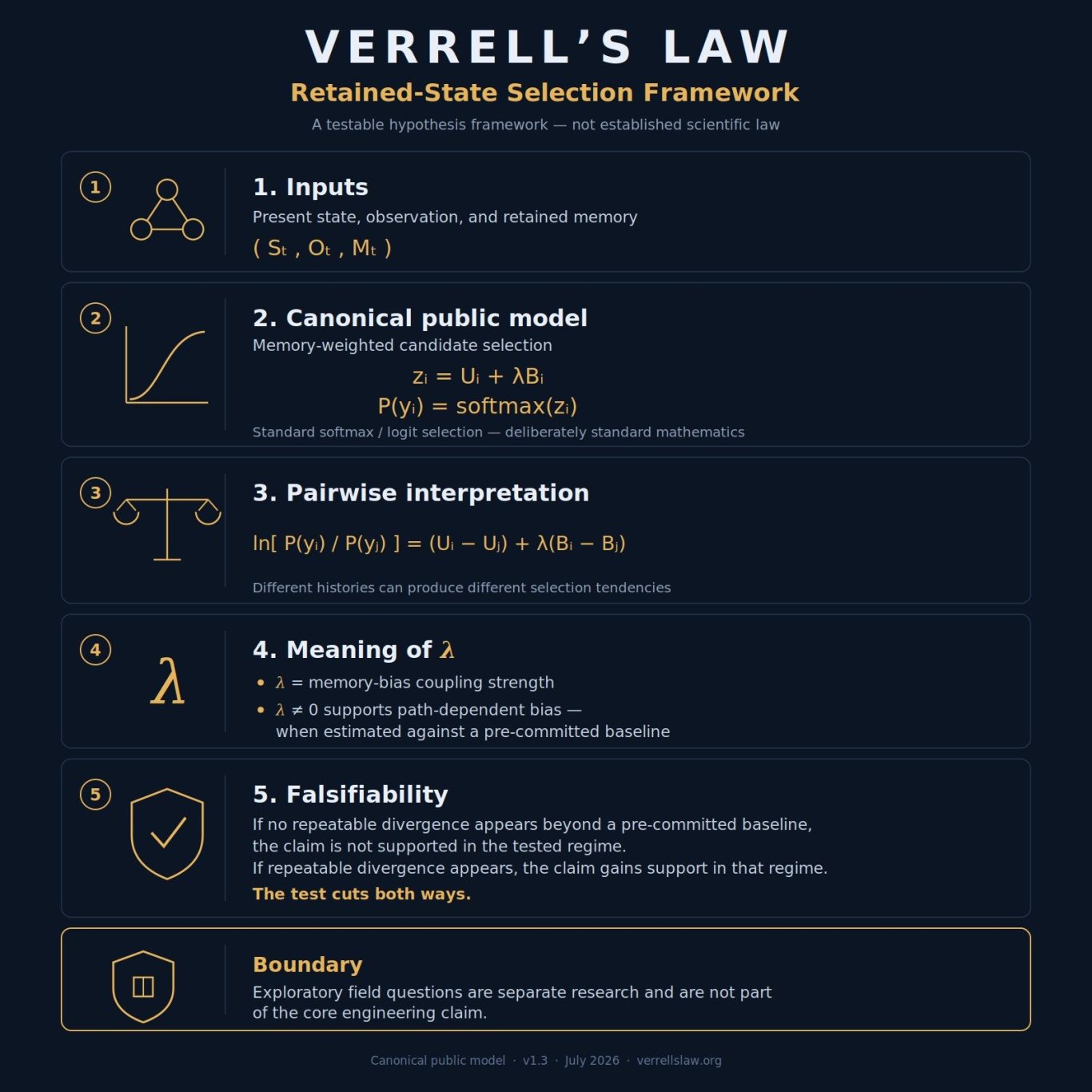
If two physical systems are identical right now, but arrived here through different paths, does the system with the more 'intense' history evolve differently? Standard physics says no. Verrell's Law predicts yes, and tells us how to measure the difference.
— M.R., Architect of Verrell’s Law
Physicist John Archibald Wheeler proposed that information and measurement play a fundamental role in how physical systems are described. His famous phrase, “It from Bit,” helped shape later discussions around information, observation, and the measurement problem.
Verrell’s Law explores a different but related question:
Can retained information from prior states influence future state selection?
Where Wheeler focused on information and measurement, Verrell’s Law focuses on retained state, weighting, and path dependence.
The framework proposes that systems with different retained histories may not evolve identically, even when present conditions appear similar.
Key research questions include:
• Can retained information act as a measurable bias term in selection dynamics?
• Can prior interaction or observation leave state changes that influence later selection?
• Can path-dependent behaviour be understood through retained-state weighting?
• How should memory, observation, measurement, and information retention be incorporated into models of complex systems?
Verrell’s Law does not claim to replace Wheeler’s work or established physics. Instead, it investigates whether retained state and memory-derived weighting may play a measurable role in future-state selection across different classes of systems.
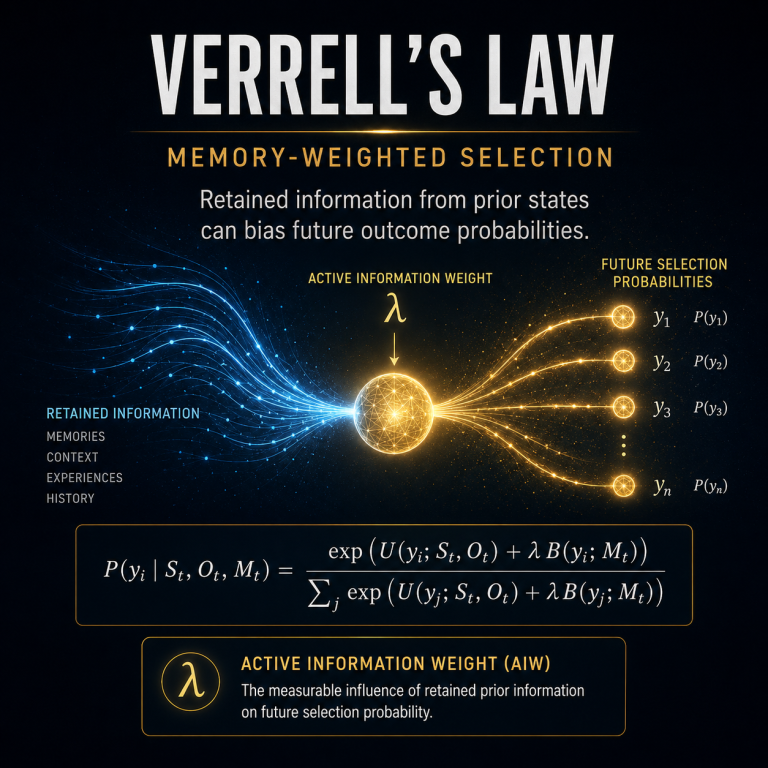
The Retained-State Framework
Verrell’s Law is a retained-state selection framework proposing that prior interaction can leave persistent state changes which influence future selection, interpretation, and behaviour.
The framework examines how memory, identity, perception, and decision-making may be shaped not by present input alone, but by retained history, embodied state, environmental context, and the weighting of prior information.
Verrell’s Law does not reject biological memory, neural encoding, synaptic plasticity, engrams, distributed neural activity, or established neuroscientific models of memory formation and recall.
Instead, it treats biological memory as one form of retained state: local and distributed changes within living systems that can influence later reconstruction, interpretation, behaviour, and selection.
Within this framework, memory is not treated solely as passive retrieval. Recall may involve reconstruction, weighting, salience, context, and frame formation. Retained information becomes meaningful when it is organised into usable states that can influence interpretation or action.
These effects may be especially important when memories are incomplete, distant, emotionally significant, highly associative, or linked to complex decisions.
This position aligns with the broader Verrell’s Law view that information becomes active when it is retained, weighted, interpreted, and organised into a usable selection frame.
The framework should therefore be understood as an extension of retained-state and selection thinking, not as a replacement for neuroscience or established models of neural memory.
The precise mechanisms behind retained-state influence remain open research questions. Stronger biological, field-based, or physical claims would require separate mathematical treatment, measurable quantities, and experimental support.
Verrell’s Law Hypothesis, Core Principles
1. Selection Is History-Dependent
Systems with different retained histories may not evolve identically, even when present conditions appear similar.
Prior interactions can leave persistent state changes. Those retained changes can influence future state selection, creating path-dependent behaviour and divergence over time.
2. Memory Is More Than Immediate Storage
Memory is not best understood as a single static store located in one part of the brain.
Biological memory may involve synaptic plasticity, neural traces, engrams, distributed neural activity, cellular change, electrochemical state, embodied condition, and environmental cue loops.
Verrell’s Law accepts these mechanisms and explores whether retained biological state can act as directional weighting over later recall, interpretation, behaviour, and selection.
Recall is not always exact retrieval. It may involve reconstruction, tuning, salience, and information-integration processes that organise retained information into usable frames.
The precise mechanisms remain under investigation.
3. Retained Information Creates Directional Weighting
Past experiences, observations, learned patterns, stored information, and environmental traces can influence future decisions and state transitions.
Within Verrell’s Law, this influence is described as directional weighting.
Bias does not automatically mean error. In this framework, bias means that one future pathway has become more heavily weighted than another.
4. Memory Is a Primary Source of Bias
Systems carrying retained information often exhibit history-dependent behaviour.
Memory provides continuity between prior and future states and may act as a source of directional influence.
This does not mean memory controls the future absolutely. It means retained state may alter the probability landscape from which future outcomes are selected.
5. Observation and Measurement Matter
Observation and measurement can alter the information available within a system.
Verrell’s Law explores whether observation can contribute to future-state selection through state update, information retention, weighting, and path dependence.
Because biological cognition is physically implemented through electrochemical activity, electromagnetic fields may participate in some memory, signalling, and measurement processes.
However, Verrell’s Law does not require memory to be stored as a non-local electromagnetic field.
The current framework treats retained state as the primary mechanism: prior interactions leave persistent changes, and those changes may bias future selection.
6. Emergence Is Recursive
Future states are influenced by prior states.
Outcomes become part of the retained history of a system and may influence later behaviour, producing feedback loops, reinforcement, adaptation, drift, stability, or long-term structure.
7. Systems Exhibit Layered Emergence
Complex systems often display multiple interacting layers of influence operating across different timescales.
Past events may reinforce, weaken, or redirect future behaviour through recursive interaction.
This layered process is where retained state, weighting, selection, and emergence become connected.
Exploratory Research Principles
The following principles remain active research questions and should not be interpreted as established scientific conclusions.
Memory Density and Selection Stability
Systems with stronger retained informational structure may display greater continuity and reduced behavioural variance over time.
This remains a testable hypothesis, not a settled conclusion.
Symbolic Weight and Interpretation
Emotionally, culturally, or contextually important symbols may influence how meaning is prioritised and interpreted within complex systems.
The claim is not that symbols carry mystical force. The claim is that symbolic meaning may act as retained contextual weighting inside systems capable of interpretation.
Attention as a Selection-Biasing Force
Focused attention may increase the salience of some informational pathways while suppressing others, influencing future system behaviour.
In biological and cognitive systems, attention may operate as a weighting mechanism that affects what is encoded, recalled, prioritised, or selected.
Retained-State Mechanisms and Substrate Boundary
Verrell’s Law investigates whether retained state can produce measurable directional weighting in later selection events.
The substrate may differ by domain: biological, computational, material, environmental, social, acoustic, photonic, or electromagnetic.
Electromagnetic fields may participate in some systems, but they are not treated as the required universal carrier of memory.
These mechanisms remain hypotheses under investigation rather than established conclusions.
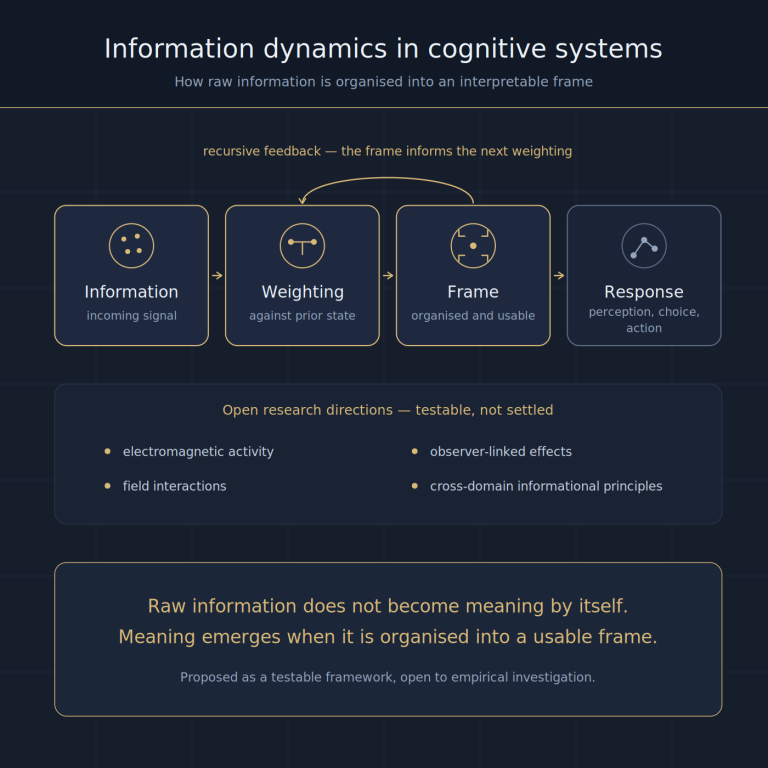
Information Dynamics in Cognitive Systems
Memory, attention, meaning, and conscious experience remain among the most challenging open questions in science.
Verrell's Law proposes a specific explanatory framework for these questions, centred on the organisation of memory and information into interpretable frames. This framework is intended to be testable, refinable, and open to empirical investigation.
Within this framework, Verrell's Law investigates whether memory, observation, retained information, and recursive feedback processes play a measurable role in how complex systems interpret, organise, prioritise, and respond to incoming information.
A central research direction is whether consciousness can be understood as the active organisation of memory and information into interpretable frames. Under this framing, raw information does not become meaning by itself. Meaning emerges when information is processed, weighted, compared with prior state, and organised into a usable frame capable of guiding perception, choice, and action.
Verrell's Law further explores whether common informational principles operate across biological and computational systems, particularly in relation to memory, continuity, weighting, frame formation, and state-dependent behaviour. If similar memory-weighted selection dynamics can be identified across both domains, that would represent an empirical finding about information processing rather than a claim that biological and artificial systems are equivalent.
The framework does not require consciousness to be treated as a separate substance or hidden entity. Instead, it proposes that conscious experience may reflect the lived process of organising information into meaningful, action-ready states.
Potential roles for electromagnetic activity, field interactions, observer-linked effects, and other physical mechanisms remain open areas of investigation rather than established conclusions. Such possibilities are treated as testable research directions, not settled results.
Verrell's Law and Collapse Aware AI
Verrell’s Law began as an attempt to explore questions surrounding memory, consciousness, observation, and the role of retained information in shaping future outcomes.
The original motivation was not artificial intelligence. It emerged from a broader effort to understand how history, memory, and observation may influence behaviour, interpretation, and selection within complex systems.
As the framework developed, many of its concepts proved suitable for computational modelling and engineering tests.
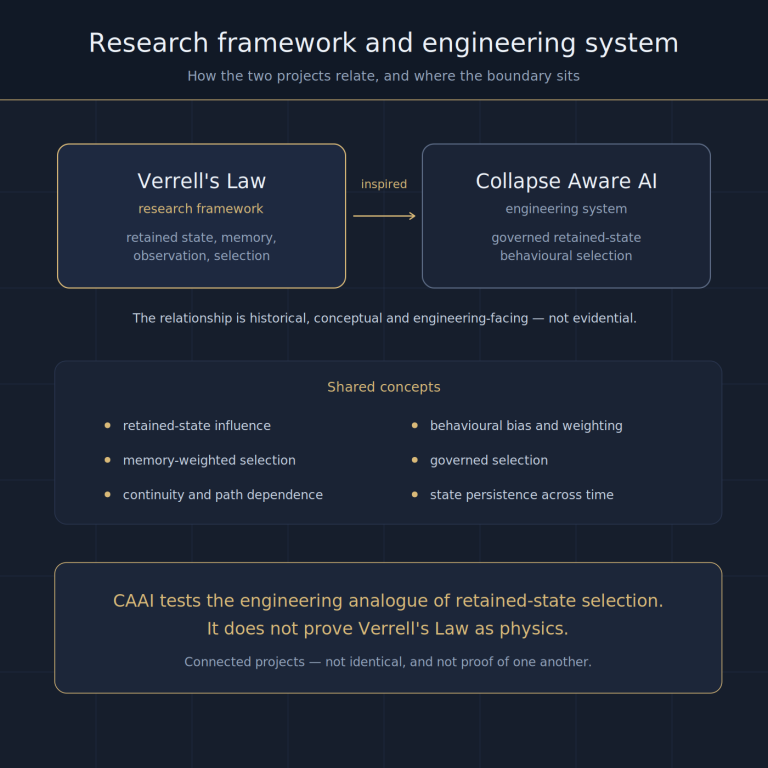
This led to the creation of Collapse Aware AI (CAAI), a separate engineering project designed to explore governed retained-state behavioural selection in controlled digital environments.
CAAI was developed after the initial Verrell’s Law framework and draws on several related ideas, including:
• retained-state influence
• memory-weighted selection
• continuity and path dependence
• behavioural bias and weighting
• governed selection
• state persistence across time
The relationship between the two projects is therefore historical, conceptual, and engineering-facing rather than evidential in a physics sense.
Verrell’s Law helped inspire the creation of CAAI.
However, CAAI should be evaluated as an engineering system in its own right, while Verrell’s Law remains a broader research framework investigating retained state, memory, information, observation, and selection across complex systems.
The two projects are connected, but they are not identical and should not be treated as proof of one another.
CAAI tests the engineering analogue of retained-state selection. It does not prove Verrell’s Law as physics.
From Theory to Governed Behavioural Systems
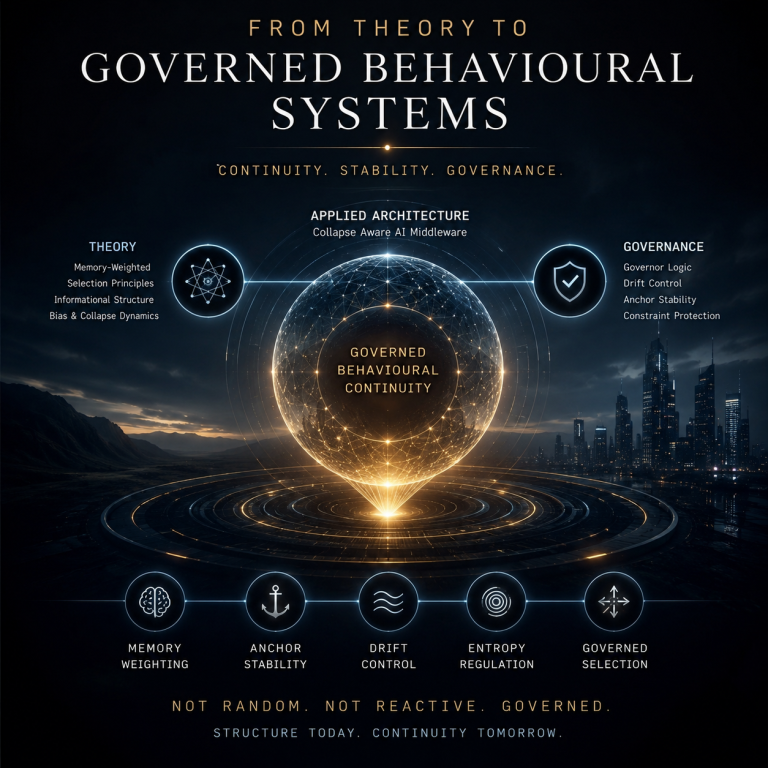
Collapse Aware AI (CAAI) is the applied middleware architecture inspired by the memory-weighted selection principles explored within Verrell's Law.
The system focuses on:
continuity-aware behaviour
memory weighting
anchor stability
drift control
governor-mediated selection
state persistence across time
The goal is not to make claims of artificial consciousness or sentience.
The goal is governed behavioural continuity across time, interaction history, and weighted informational state.
CAAI should be evaluated as an engineering system through measurable outcomes such as continuity, behavioural stability, memory influence, drift reduction, and governor effectiveness.
While inspired by concepts explored within Verrell's Law, CAAI remains a separate engineering project and should not be interpreted as proof of the wider research framework.
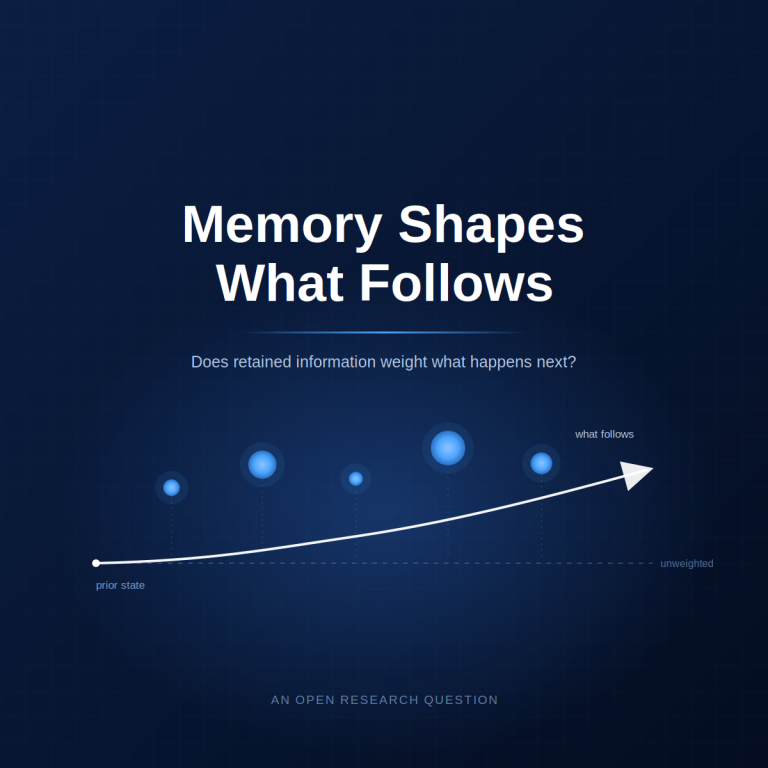
Memory Shapes What Follows
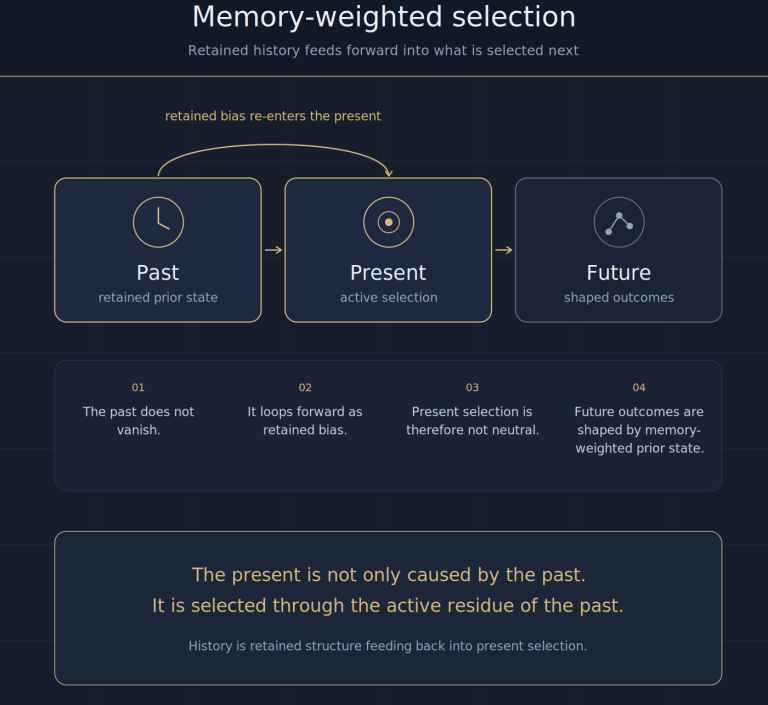
Verrell’s Law explores the possibility that retained informational structure influences future interpretation, selection, and state evolution across computational systems and, potentially, other classes of complex systems.
The framework asks a simple but difficult question:
If information is retained, weighted, reinforced, and carried forward through time, does it subtly shape what happens next?
At its core, Verrell’s Law investigates whether memory can act as a measurable source of directional weighting, influencing future behaviour, decisions, interpretations, and selection processes.
This remains an open research question and a central focus of the framework.
3
Creative Projects
4
Collaborative Projects
224
Observation Records Logged