Collapse Aware AI — Architecture Overview
Collapse-Aware AI (CAAI) is a behavioural middleware architecture built on Verrell’s Law, where memory and continuity arise from bias-weighted information collapse rather than static state storage.
Instead of relying on short-term prompt context or full transcript history, CAAI maintains structured behavioural memory that influences how outcomes resolve over time. These bias structures modify the scoring and selection of candidate outputs, allowing the system to maintain continuity and identity across interactions without storing raw conversation logs.
At the centre of the architecture is a governor-controlled collapse mechanism that regulates behavioural drift. Rather than suppressing drift entirely, CAAI measures and manages it, treating drift as a meaningful system signal that can be stabilised, redirected, or allowed to evolve depending on context.
This approach produces stable yet adaptive behaviour across long interaction horizons. Decisions are not recomputed from scratch on every request; instead, past events influence future resolution through weighted memory structures that shape probability distributions prior to final output selection.
CAAI therefore functions as a behavioural layer around existing models. Base models generate possible responses or actions, while CAAI governs which of those possibilities collapse into the final output.
The result is a system capable of maintaining consistent behaviour, long-term context, and adaptive identity without the brittleness of prompt engineering or the privacy risks of full transcript storage.
High-Level Architecture
CAAI operates as an external behavioural engine layered around standard AI models or decision systems.
When a request is processed, the base model generates a set of candidate responses or actions. These candidates are then evaluated by the CAAI bias engine, which applies structured memory influence before selecting the final outcome.
The architecture therefore introduces a governed collapse stage between model generation and output. This stage uses memory-weighted bias structures and stability controls to determine which candidate response becomes the final result.
Behaviour evolves over time through structured memory updates that capture salience, recency, and contextual importance rather than raw interaction history.
Phase-1 Core Architecture
The Phase-1 system implements the foundational collapse-aware behaviour engine used in the current middleware build.
Bias Engine
Maintains structured behavioural bias vectors derived from past interactions. These vectors influence candidate scoring during collapse selection without storing transcripts.
Weighted Moments
Encodes the salience and contextual importance of events, allowing past interactions to influence future behaviour through weighted memory structures.
Strong Memory Anchors
High-weight priors that stabilise identity and long-term behavioural tendencies across sessions.
Continuity Memory
Maintains cross-session behavioural persistence using structured memory with controlled decay rather than full historical logs.
Governor v2 (Collapse Governance)
A supervisory stability layer that evaluates collapse outcomes and enforces behavioural consistency, drift regulation, and operational constraints.
Phase-2 Extensions
Future phases expand the architecture with additional probabilistic and behavioural modelling layers that refine how collapse decisions occur.
Emotional Superposition Engine
Models parallel affective state influence during collapse weighting.
Bayes Bias Module
Applies probabilistic priors to collapse selection, enabling interpretable influence over decision outcomes.
THB (Truth–Hedge Bias)
A stability signal that measures confidence versus hedging behaviour in model outputs.
MFIC (Multi-Factor Intention Cloud)
Models multiple possible behavioural trajectories before collapse resolution.
SBML (Shared Bias Memory Loop)
Provides adaptive start conditions by loading relevant prior bias states, reducing cold-start behaviour.
Layer-0 Suppressor Compensation
Counteracts low-level hedging attractors within base model behaviour.
Drift and Stability Management
Detects and regulates long-horizon behavioural drift across interactions.
Timing and Recency Weighting
Applies time-based decay and silence-aware weighting to maintain coherent behavioural evolution.
Verrell, M. (2026). Collapse-Aware AI (CAAI): .Zenodo. https://doi.org/10.5281/zenodo.18643490
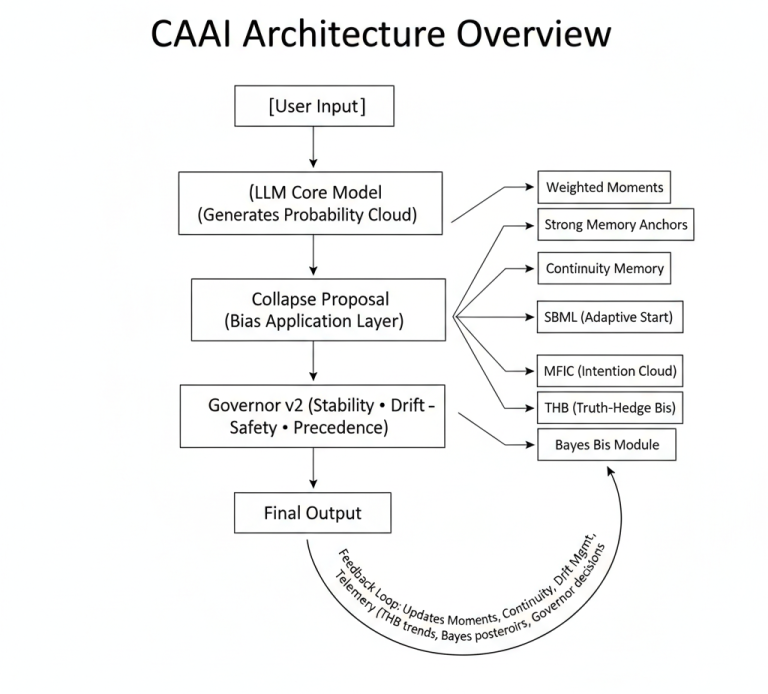
Collapse Aware AI — Behavioural Flow Architecture
A[User Input]
B[Base Model / Worker
(Generates candidate responses
or actions)]
C[Crown Bias Engine
Weighted Moments
Strong Memory Anchors
Continuity Memory
(Candidate scoring)]
D[Collapse Selection
(Bias-weighted candidate resolution)]
E[Governor v2
Stability Control
Drift Regulation
Safety & Context Gating]
F[Final Output]
G[Continuity Memory Update
(Structured memory persistence)]
A --> B --> C --> D --> E --> F --> G
G --> C
Collapse Governance Summary
Collapse-Aware AI introduces a governed collapse layer between model generation and final output. Instead of returning the first response produced by a model, the system evaluates multiple candidate outputs and selects the final result through a memory-weighted bias process.
During this stage, candidate responses are scored using structured behavioural memory — including Weighted Moments, Strong Memory Anchors, and Continuity Memory — before a final selection occurs. The selected output is then validated by the Governor, which regulates stability, drift behaviour, and operational constraints.
This architecture allows behaviour to remain consistent across long interaction horizons while still adapting to new context. Outputs therefore evolve over time through structured memory influence rather than prompt steering, post-generation rewriting, or full transcript storage.
By introducing a governed collapse stage, CAAI transforms stateless model responses into continuity-aware behaviour capable of maintaining identity, context, and adaptive stability across sessions.
Glossary (Public Concepts)
Collapse-Aware AI operates as a middleware layer rather than a standalone model, meaning it can govern behaviour for many different underlying AI systems.
Phase-1 Core Components
Weighted Moments – Structured memory elements that encode salience, recency, and contextual importance, allowing past events to influence future collapse decisions.
Strong Memory Anchors – High-weight behavioural priors that stabilise identity and long-term behavioural tendencies.
Continuity Memory – A structured memory layer that preserves behavioural context across interactions without storing full transcripts.
Bias Engine – The behavioural scoring system that evaluates candidate responses using structured memory influence.
Governor v2 – A stability and safety controller that regulates collapse outcomes, ensuring behavioural consistency and preventing uncontrolled drift.
Future Architecture Modules (Phase-2 Research)
Emotional Superposition Engine – Parallel affective state modelling that can influence collapse weighting.
Bayes Bias Module – Probabilistic priors applied to collapse selection for interpretable behavioural influence.
THB (Truth–Hedge Bias) – A stability signal that measures confidence versus hedging behaviour in model outputs.
MFIC (Multi-Factor Intention Cloud) – A probabilistic model of multiple potential behavioural trajectories prior to collapse.
SBML (Shared Bias Memory Loop) – A mechanism designed to reduce cold-start behaviour by loading relevant prior bias states.
Design Philosophy
Traditional AI treats each interaction as isolated. CAAI introduces memory as bias — a persistent field that shapes response selection without storing raw data. This allows continuity, stability, and emergent personality while preserving privacy.
Privacy & Proprietary Boundary
CAAI does not store raw transcripts or personal data.
Only structured behavioural vectors persist between sessions.
This page is a high-level conceptual overview only. Parameterisation, update rules, thresholds, training pipelines, kernel math, routing logic, Governor internals, and collapse equations remain proprietary to Inappropriate Media Limited.
Scope & Non-Goals
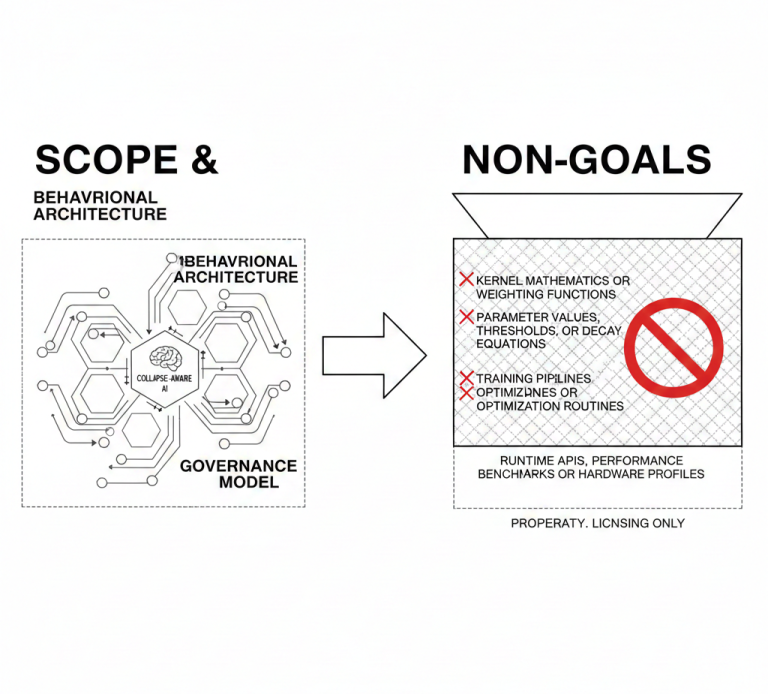
This page describes the behavioural architecture and governance model of Collapse-Aware AI.
It does not disclose:
Kernel mathematics or weighting functions
Parameter values, thresholds, or decay equations
Training pipelines or optimization routines
Runtime APIs, performance benchmarks, or hardware profiles
Those elements remain proprietary and are provided only under licensing and evaluation agreements.
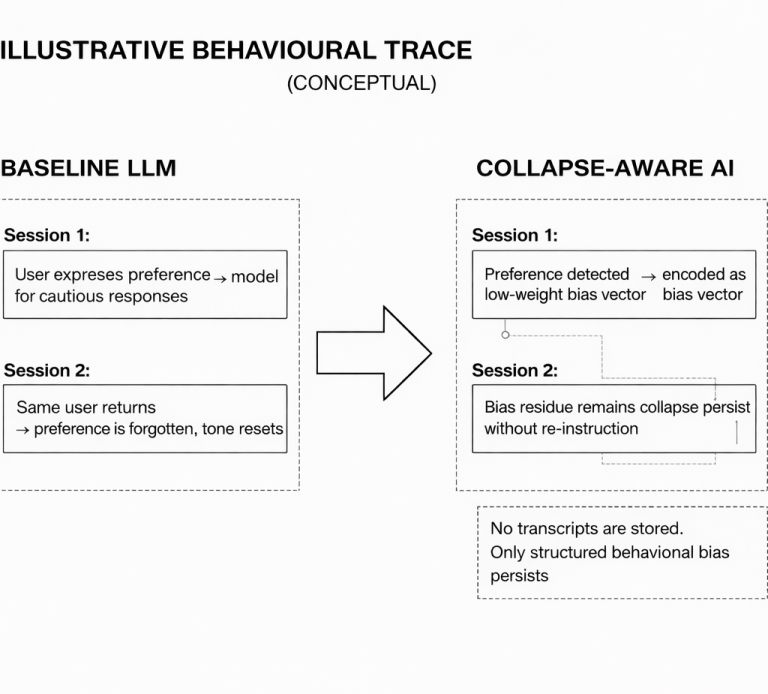
Illustrative Behavioural Trace (Conceptual)
Baseline LLM:
Session 1: User expresses preference for cautious responses → model complies
Session 2: Same user returns → preference is forgotten, tone resets
Collapse-Aware AI:
Session 1: Preference detected → encoded as a low-weight bias vector
Session 2: Bias influences collapse routing → response remains cautious without re-instruction
No transcripts are stored. Only structured behavioural bias persists.